Introduction
One of the most common emails EPC contractors send looks something like this:
“Please provide your best price for a labor camp.”
No workforce numbers.
No project location.
No room configuration.
No climate requirements.
No delivery schedule.
Just a request for a price.
The problem?
A prefab labor camp cost is not a single number.
Two projects requiring accommodation for 1,000 workers can have dramatically different budgets.
One may be located near a major city with established infrastructure.
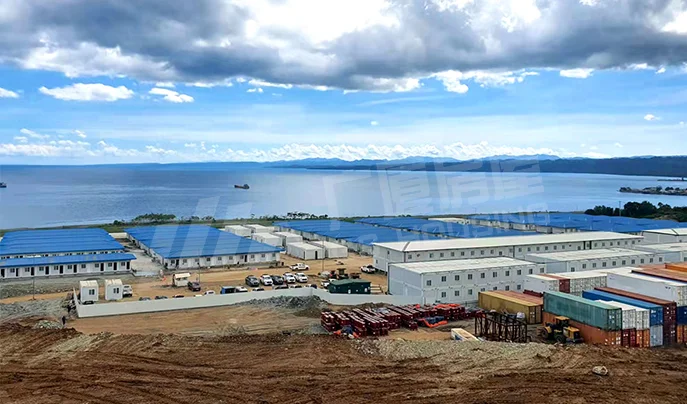
Another may sit deep inside a mining region, remote oilfield, desert project, or island development where every truck movement must be carefully planned.
Both need accommodation.
Both need offices.
Both need dining facilities.
Yet their final project costs may differ by millions of dollars.
That’s why experienced procurement teams rarely ask:
“What does one container house cost?”
They ask:
“What will the entire camp cost to transport, install, operate, and expand?”
And that’s usually the better question.
Why Prefab Labor Camp Cost Is Usually About Much More Than Buildings
Many first-time buyers focus on unit pricing.
Understandably.
It feels like the easiest comparison.
A container unit costs X.
Another supplier offers Y.
Decision made.
Not quite.
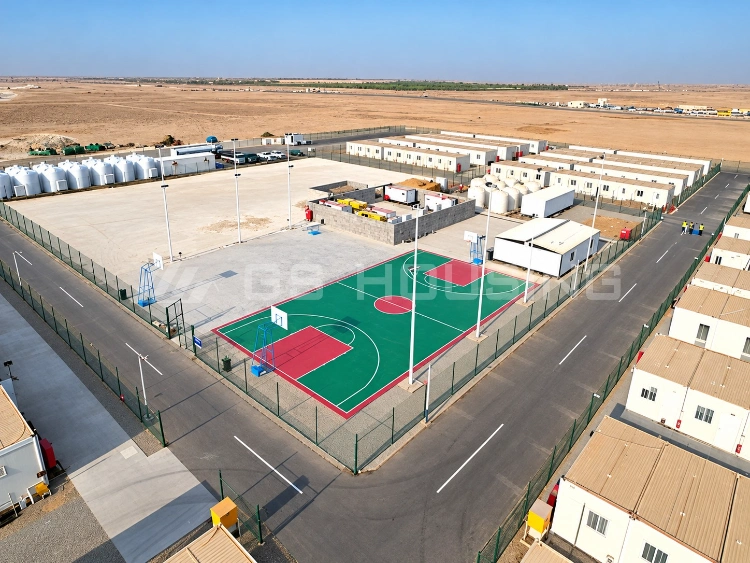
A labor camp functions as a complete operating system.
Accommodation buildings are only one component.
A typical workforce camp may include:
- Worker dormitories
- Supervisor accommodation
- Office buildings
- Dining halls
- Industrial kitchens
- Toilet facilities
- Shower blocks
- Laundry buildings
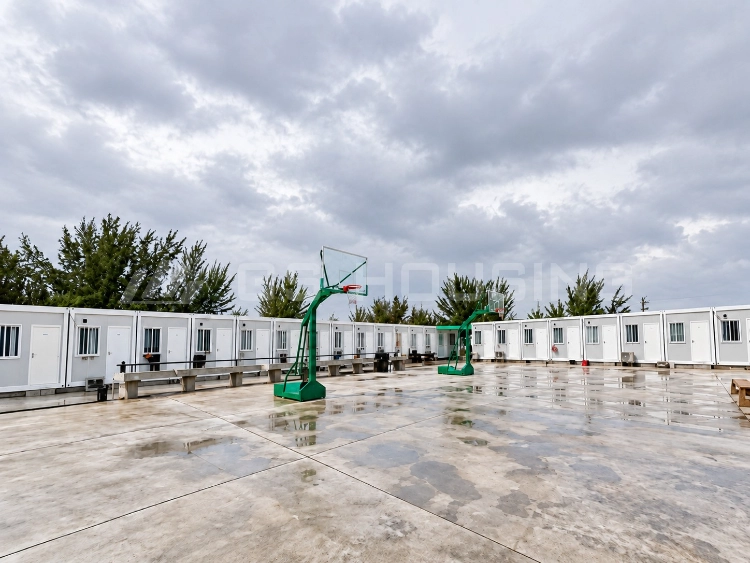
- Recreation spaces
- Medical facilities
The result?
A supplier offering the lowest accommodation price may not deliver the lowest overall project cost.
Especially when infrastructure, transportation, installation, and future expansion are considered later.
This is why many EPC contractors evaluate complete prefabricated workforce camp solutions rather than comparing individual buildings one by one.
The First Factor Affecting Prefab Labor Camp Cost: Workforce Size Changes Everything
This sounds obvious.
Yet it creates more pricing variation than many buyers expect.
A 200-person camp and a 2,000-person camp do not scale proportionally.
Certain facilities grow much faster than accommodation itself.
For example:
- Larger dining halls
- Additional kitchens
- More wastewater treatment capacity
- Larger power systems
- Additional office space
- Medical facilities
- Security infrastructure
In many projects, accommodation buildings represent only part of the total budget.
Support infrastructure often grows faster than room numbers.
That’s why suppliers usually ask about workforce size before discussing pricing.
Without it, any quotation is mostly guesswork.
Why Room Configuration Can Change Worker Accommodation Cost More Than Expected
Another misconception:
More workers automatically mean higher cost.
Not always.
Room layout matters.
A lot.
Consider three common configurations:
- 4-person rooms
- 2-person rooms
- Single occupancy rooms
The workforce remains identical.
The building footprint does not.
Single-room accommodation typically requires:
- More walls
- More doors
- More corridors
- More HVAC capacity
- Larger overall structures
The difference becomes substantial at scale.
For long-term mining projects, oilfield camps, and management accommodation zones, room configuration can influence worker accommodation cost far more than many buyers initially assume.
Why Insulation, Fire Ratings, and Wind Resistance Often Affect Modular Camp Cost More Than Steel
Many buyers immediately focus on steel structure specifications.
Ironically, insulation and compliance requirements often create larger cost differences.
A camp designed for tropical Southeast Asia will not require the same performance as one operating in:
- Northern Australia
- Saudi Arabia
- Kazakhstan
- Canada
Project requirements may include:
- Enhanced thermal insulation
- Fire-rated wall systems
- Cyclone resistance
- High wind-load engineering
- Corrosion-resistant coatings
The important point is this:
Higher specifications are not necessarily expensive.
Over-specifying can be.
Under-specifying can be even more expensive later.
The cheapest wall panel on paper can quickly become the most expensive choice once maintenance, energy consumption, and replacement costs start accumulating.
Transportation Cost: The Budget Item That Surprises Most EPC Contractors
For many international projects, transportation becomes one of the largest cost variables.
Sometimes larger than buyers expect.
A labor camp shipped to a nearby city may have relatively predictable freight expenses.
The same camp delivered to a remote mining site, desert project, or island development may require:
- Multiple transportation stages
- Inland trucking
- Port handling
- Crane unloading
- Specialized logistics support
This is why transportation is often quoted separately from factory pricing.
One project manager described it perfectly:
“We spent more time optimizing logistics than negotiating buildings.”
That statement sounds exaggerated.
It usually isn’t.
In some remote projects, the difference between a profitable camp deployment and an over-budget project comes down to logistics rather than the buildings themselves.
A camp delivered to a port city is one thing.
A camp delivered another 800 or 1,200 kilometers inland is something entirely different.
Every truck movement costs money.
Every transfer point introduces risk.
Every delay affects workforce mobilization schedules.
This is also where modular design begins to show its value.
Systems optimized for containerized transportation can significantly reduce shipping volume and improve loading efficiency, particularly for projects where logistics represent a major percentage of the overall budget.
A Real Example: When Logistics Became the Main Cost Driver
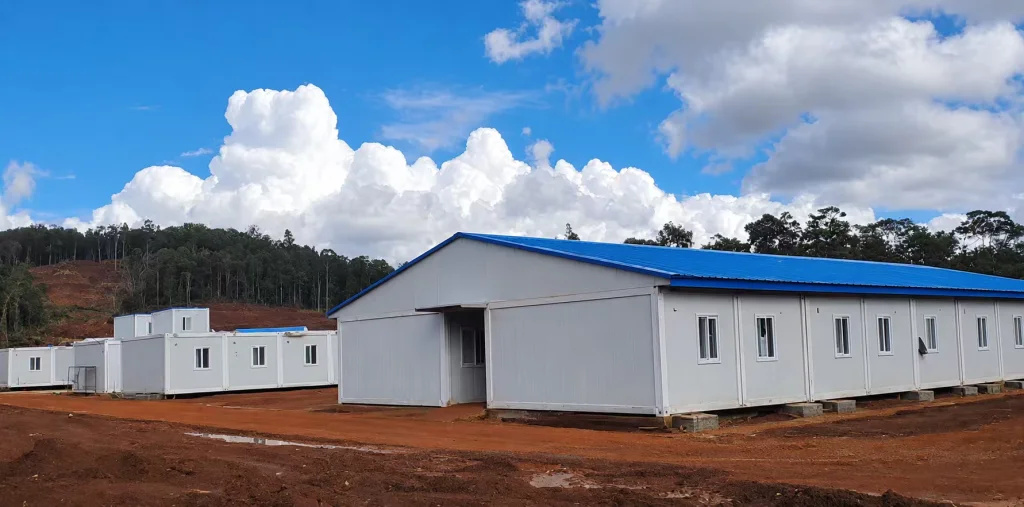
One recurring pattern across many projects delivered through GS Housing’s global workforce accommodation portfolio is that transportation costs increase faster than buyers expect.
In several overseas workforce camp developments delivered by GS Housing, project teams initially focused on factory pricing.
Later, detailed logistics planning revealed that inland transportation, crane operations, and site access requirements would have a greater impact on the final budget than minor differences in building costs.
The lesson was simple:
The cheapest building quotation is not always the lowest-cost project solution.
Installation Cost Depends More on Site Conditions Than the Buildings Themselves
Buyers often ask:
“How much will installation cost?”
The honest answer is:
It depends on the site.
A prepared site with existing utilities, level foundations, and crane access can often be installed efficiently.
A remote site may require additional equipment, labor, and time.
The same camp can generate very different installation budgets depending on local conditions.
That’s why accurate quotations require project-specific information rather than generic assumptions.
The Certification Requirements Behind Labor Camp Cost That Many Buyers Forget
Certification rarely appears in early budget discussions.
Until customs clearance starts.
Then it suddenly becomes important.
Depending on the destination country, projects may require:
- SASO certification
- CE certification
- Australian compliance standards
- Fire safety approvals
- Electrical certifications
Obtaining compliance documentation requires time and resources.
Ignoring certification during budgeting often creates unexpected costs later.
Or worse.
Project delays.
The Most Expensive Mistake? Comparing a Single Container House Instead of the Entire Camp
This may be the most important point in the article.
A labor camp is not a collection of buildings.
It is an operating environment.
Two suppliers may offer identical container houses.
Yet one proposal includes:
- Infrastructure planning
- Camp layout optimization
- Transportation support
- Installation guidance
- Future expansion planning
The other may not.
Comparing only the unit price ignores most of the project.
For EPC contractors, the lowest container house quotation is rarely enough information to identify the best overall solution.
What Information Should You Prepare Before Requesting a Prefab Labor Camp Cost Estimate?
The fastest way to receive an accurate quotation is providing complete project information.
At minimum, suppliers typically need:
Workforce Information
- Total workforce
- Room occupancy requirements
- Supervisor accommodation requirements
Project Location
- Country
- Region
- Site conditions
Camp Facilities
- Offices
- Dining halls
- Kitchens
- Toilets
- Laundry facilities
- Recreation areas
Technical Requirements
- Wind resistance
- Fire ratings
- Insulation specifications
- Local compliance requirements
Project Schedule
- Required delivery date
- Installation timeline
The more complete the information, the more accurate the quotation becomes.
And usually, the faster it arrives.
Final Thoughts
The question isn’t really:
“How much does a prefab labor camp cost?”
The better question is:
“What does the project actually require?”
Because camp pricing is influenced by workforce numbers, accommodation standards, climate conditions, transportation routes, compliance requirements, installation complexity, and future expansion plans.
The contractors who obtain the most accurate budgets usually spend less time comparing unit prices and more time defining project requirements.
If you’re still evaluating accommodation standards, camp layouts, or facility combinations, reviewing different worker accommodation configurations for large-scale workforce projects can often help identify the real cost drivers before procurement begins.
And if you already know your workforce size, project location, and expected deployment schedule, a preliminary camp layout can often reveal budget risks long before formal tendering starts. Sharing those details with the GS Housing project team for an initial layout review and budget assessment allows you to receive a project-specific recommendation rather than a generic price range—often making procurement decisions much easier later in the process.