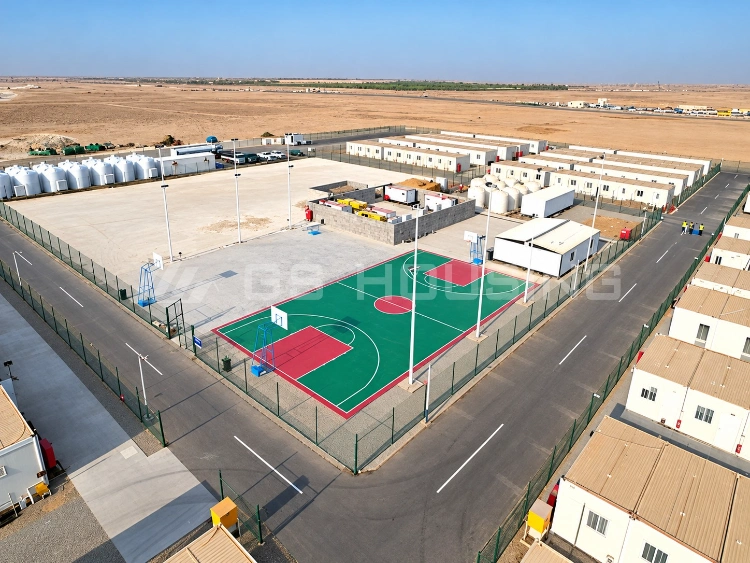
Infrastructure projects often require project teams to work at locations where permanent offices and accommodation are not yet available. For contractors and EPC teams working in remote areas, the site needs to provide both a practical workspace and suitable accommodation close to the project area.
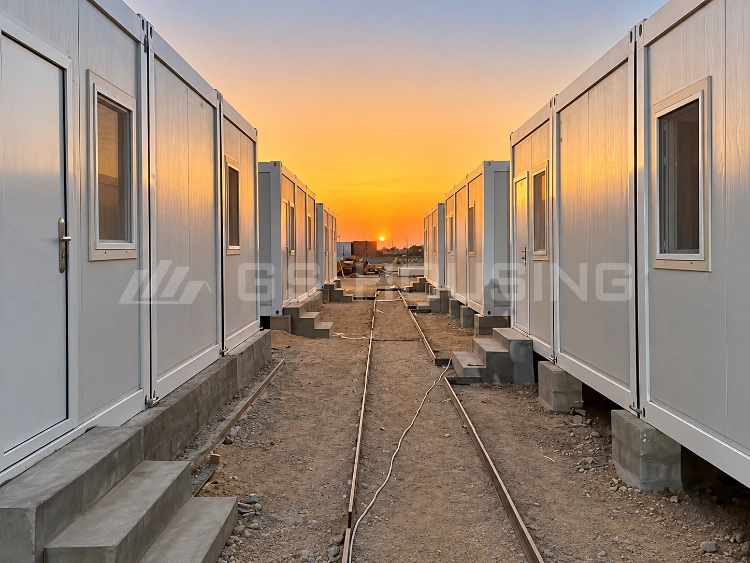
2025年、GSハウジングは18戸を供給した フラットパック式コンテナハウス units for the Arua Enyau water supply project in Uganda. The units were arranged in single-storey rows to create a combination of project offices and employee accommodation, providing a self-contained modular site facility for the construction team.
Rather than building separate permanent facilities, the project used prefabricated modular units that could be connected horizontally and arranged according to the site’s functional requirements. This case shows how construction site accommodation can combine working and living spaces within one flexible modular solution for remote infrastructure projects.
プロジェクトの概要
| プロジェクト年度 | 2025 |
| 場所 | Arua, Uganda |
| プロジェクト | Arua Enyau Water Supply Project |
| 製品 | Flat Pack Container House |
| 数量 | 18ユニット |
| 編曲 | Single-storey, horizontally connected rows |
| 用途 | Site offices and employee accommodation |
| 建物の種類 | Modular site office and accommodation facility |
| 主な利用者 | Project staff and construction personnel |
| 財団 | Concrete footings with step access |
| 施工方法 | 工場でのプレハブ製造+現場での組み立て |
From Project Requirements to a Modular Site Solution
For a water supply and infrastructure project, the construction team needs more than equipment and materials. Engineers, supervisors and other project personnel may need to remain close to the work area throughout the construction period, creating a need for both workspace and accommodation.
The Arua Enyau project is located in northwestern Uganda, where dedicated site facilities were required close to the construction area. For the project team, this created a need for both workspace and accommodation on site.
The project used 18 modular units to address these requirements. Instead of treating the units as individual temporary rooms, they were connected horizontally in long rows to provide two essential functions: site office space for project operations and accommodation for employees.
A site office and accommodation solution can also simplify site planning. Office units can be arranged separately from living areas while remaining within the same overall facility, allowing the project team to maintain a clear distinction between working and residential spaces. The single-storey row arrangement also keeps access straightforward and makes the facility easy to organize around the project’s daily operations.
18 Units: Factory Prefabrication and On-Site Assembly
The project used 18 flat pack container house units as the basic modular building components.
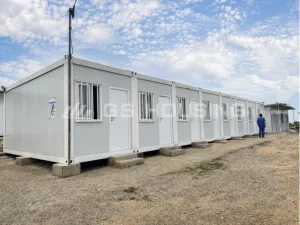
The units were prefabricated before transportation to Uganda, allowing a substantial part of the basic building preparation to be completed at the factory. After delivery to the project site, the modules were positioned on concrete footings, connected horizontally and arranged according to their intended use.
The basic process can be summarized as:
Factory production → Transportation → Site preparation and footings → On-site assembly and horizontal connection → Interior fit-out and utility connection
This approach is particularly useful for infrastructure and EPC projects where site facilities need to be established alongside the main construction work. Instead of constructing every building from individual materials at the project location, the contractor can work with standardized prefabricated units and organize them into the required site layout.
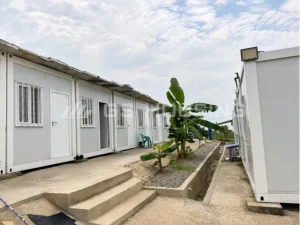
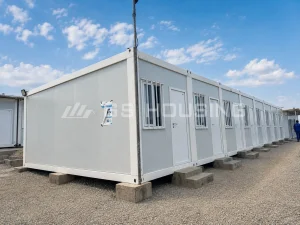
For the Arua Enyau project, the 18 units provided a repeatable building system while still allowing the office and accommodation areas to be arranged according to the project’s needs. The horizontally connected row format created a continuous building line, with individual doors and concrete steps providing access to each unit.
Combining Site Offices and Worker Accommodation
The main feature of the project is the combination of working and living functions within one modular facility.
Modular Site Office
The office areas provide workspace for project personnel involved in administration, engineering, supervision and daily coordination.
For an infrastructure project such as a water supply development, keeping project offices close to the construction area can make communication and site management more convenient. Engineers and supervisors can work near the project while remaining connected to the wider construction operation.
The use of modular site office units also allows office space to be established without constructing a conventional permanent office building at the project location.
従業員用宿泊施設
The same modular building system was used to provide accommodation for employees working on the project.
Having accommodation close to the workplace is particularly useful when the construction site is located away from established residential areas. Workers and project staff can stay near the site instead of travelling long distances between accommodation and the work area.
The accommodation units were fitted with security-barred windows and individual doors, with concrete step access from the gravel site pathways. The single-storey arrangement kept all units at ground level, simplifying access and daily movement around the site.
The accommodation areas can be planned separately from office spaces while using the same basic modular building system. This gives the project a consistent building solution across both functional zones.
Why Prefabricated Construction Fits Remote Infrastructure Projects
Infrastructure projects often operate under different site conditions from conventional urban construction. A water supply project may extend across a large area, while the active construction site may not have suitable offices or accommodation nearby.
A prefab site accommodation system provides a practical way to establish these facilities without relying entirely on existing local buildings. As a prefabricated container house system, the main structural components can be prepared before transportation, while site work focuses on footing preparation, assembly, horizontal connections and the remaining project-specific installation.
This does not remove the need for foundations, site preparation, utility connections or compliance with local requirements. These elements still need to be considered according to the project location and intended use. On the Arua Enyau site, the units were positioned on concrete footings with gravel access pathways and site lighting poles, adapted to the local ground and climate conditions.
However, modular construction can provide a more repeatable approach when contractors need several buildings for the same project. The same basic module can be used for offices, accommodation and other supporting functions, reducing the need to develop completely different building systems for each purpose.
A further advantage is that the building arrangement does not have to follow a single fixed layout. The 18 units could be organized into functional groups according to the requirements of the site. Office spaces can be separated from accommodation areas, while access routes and shared spaces can be considered as part of the overall site plan.
For EPC contractors and infrastructure developers, this combination of standardized production and flexible arrangement can be useful when project facilities need to be delivered alongside the main engineering and construction work.
プロジェクトの成果
The 2025 Arua Enyau water supply project in Uganda used 18 modular units to provide both project office and employee accommodation facilities.
By combining these functions within one modular system, the project established a practical site environment for personnel working on the infrastructure development. The units were connected horizontally in single-storey rows, positioned on concrete footings and arranged according to their different uses while maintaining a consistent prefabricated building system.
The completed facility provides project personnel with a practical working and living environment close to the Arua Enyau construction site, with individual unit access, security features and units supported on concrete footings.
The project demonstrates how construction site accommodation can be integrated with site offices rather than treated as a separate requirement. For infrastructure and EPC projects in remote locations, this can provide a practical way to establish working and living facilities close to the construction area.
よくある質問
What was the Arua Enyau project in Uganda?
The Arua Enyau project was a water supply infrastructure project in Uganda. GS Housing supplied modular units for project office and employee accommodation facilities.
How many units were used for the Uganda project?
The project used 18 flat pack container house units for site offices and employee accommodation.
Were the units used for both offices and accommodation?
Yes. The 18 units were used to provide both office space for project operations and accommodation for employees working on the project.
What is construction site accommodation?
Construction site accommodation refers to temporary or semi-permanent facilities established close to a construction project to provide living space for workers and project personnel. Depending on the project, the site facility may also include offices, meeting rooms and other support spaces.
Why combine a site office and accommodation in one modular system?
Using the same modular building system for offices and accommodation can simplify site planning and provide a consistent construction solution. It also allows working and living areas to be established close to the project site while keeping their functions separately organized.
Can flat pack container houses be used for infrastructure projects?
Yes. Flat pack container houses can be used for site offices, worker accommodation, project facilities and other temporary or semi-permanent applications, subject to structural design, site conditions and local requirements.
Looking for Construction Site Accommodation?
The 18-unit Arua Enyau project demonstrates how modular buildings can provide both site office and accommodation functions for a remote infrastructure project.
For water supply projects, EPC construction, engineering works or other remote construction sites, GS Housing can supply modular units based on the required quantity, building functions and site conditions.
If you are planning construction site accommodation, project offices or a combined office and accommodation facility, share your project location, required quantity and intended use with our team. We can discuss a suitable modular configuration for your site.
GSハウジングへのお問い合わせ to discuss your project requirements and available modular building solutions.