Introduction
A 300 person worker camp can look perfect on a layout drawing.
Until the first shift ends.
Three hundred workers return from site. The dining hall fills up. Shower queues start forming. Laundry facilities become overloaded. Supervisors struggle to find meeting space.
Suddenly, a camp that technically accommodates 300 people no longer feels designed for 300 people.
This happens more often than many EPC contractors expect.
Not because the camp is too small.
Because it was planned around room numbers instead of daily operations.
A successful 300 person worker camp is more than accommodation. It functions as a living area, dining facility, office complex, service center, and logistics hub at the same time.
That’s why experienced project teams rarely begin by asking:
“How many rooms do we need?”
Instead, they ask:
“How will 300 people actually live and work here every day?”
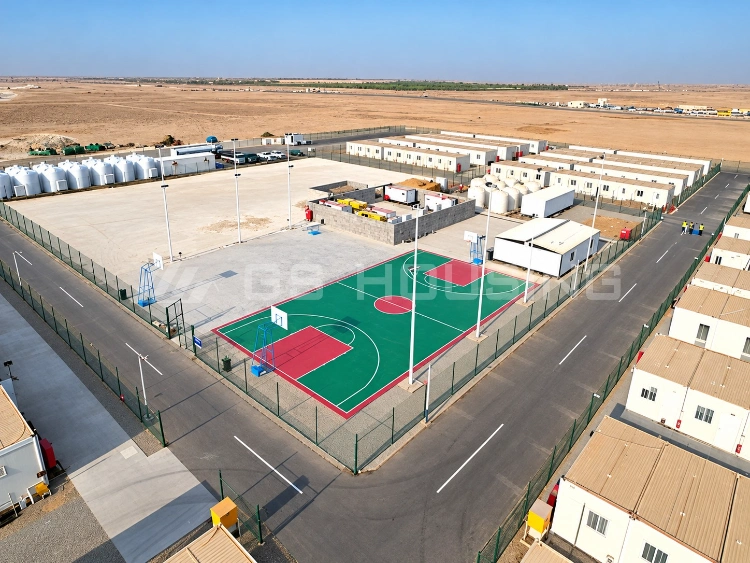
This guide explains how to plan a practical worker camp layout, what facilities are required, how to separate office and residential areas, and why many contractors design for 500 workers even when only 300 are expected initially.
Why a 300 Person Worker Camp Is Often Harder to Plan Than Many Contractors Expect
Large camps usually receive professional master planning from the beginning.
Smaller camps often don’t.
A 50-person camp is simple.
A 2,000-person camp receives dedicated planning resources.
A 300-person camp sits in the middle—large enough to require proper planning but small enough that many project teams underestimate its complexity.
That’s where problems begin.
Dining capacity gets overlooked.
Office space becomes insufficient.
Utilities are sized too tightly.
Future expansion is ignored.
Six months later, the camp still houses 300 people, but daily operations become increasingly difficult.
The First Question Every EPC Contractor Asks: How Many Rooms Does a 300 Person Worker Camp Need?
For most construction and infrastructure projects, the standard arrangement is a four-person room.
Using that configuration:
300 workers ÷ 4 persons per room = 75 accommodation rooms
But that is rarely the final number.
Most projects also require rooms for:
- Supervisors
- Engineers
- Project managers
- HSE personnel
- Security staff
As a result, a typical EPC worker accommodation project for 300 workers usually requires between 80 and 90 rooms.
Depending on the layout, that may be arranged as:
- Four accommodation blocks with around 20 rooms each
- Five accommodation blocks with 16–18 rooms each
- Separate management accommodation units
One common mistake is planning only for today’s workforce. Construction projects rarely remain static, and workforce numbers often increase during peak activity periods.
The Biggest Bottleneck in a Worker Camp Layout Usually Isn’t the Dormitory
Here’s the counterintuitive part.
Most people assume accommodation buildings are the most important part of the camp.
They’re not.
In many projects, the dining hall becomes the first operational bottleneck.
Not the bedrooms.
When shifts end, hundreds of workers may need:
- Showers
- Toilets
- Dining seats
- Laundry facilities
within a short period.
That’s why experienced camp planners often spend more time calculating dining capacity than accommodation capacity.
For a typical 300-person camp:
Dining Facilities
- 120–150 dining seats
- Industrial kitchen
- Cold storage room
- Dry storage area
Bathroom Facilities
- Distributed shower blocks
- Separate toilet facilities
- Easy maintenance access
Laundry Facilities
- Centralized laundry room
- Reserved space for future equipment
A camp may comfortably house 300 workers.
But if only 100 workers can eat at one time, daily congestion becomes unavoidable.
Why the Best Construction Camp Layouts Separate Living, Working, and Service Areas
One of the most effective construction camp layout strategies is functional zoning.
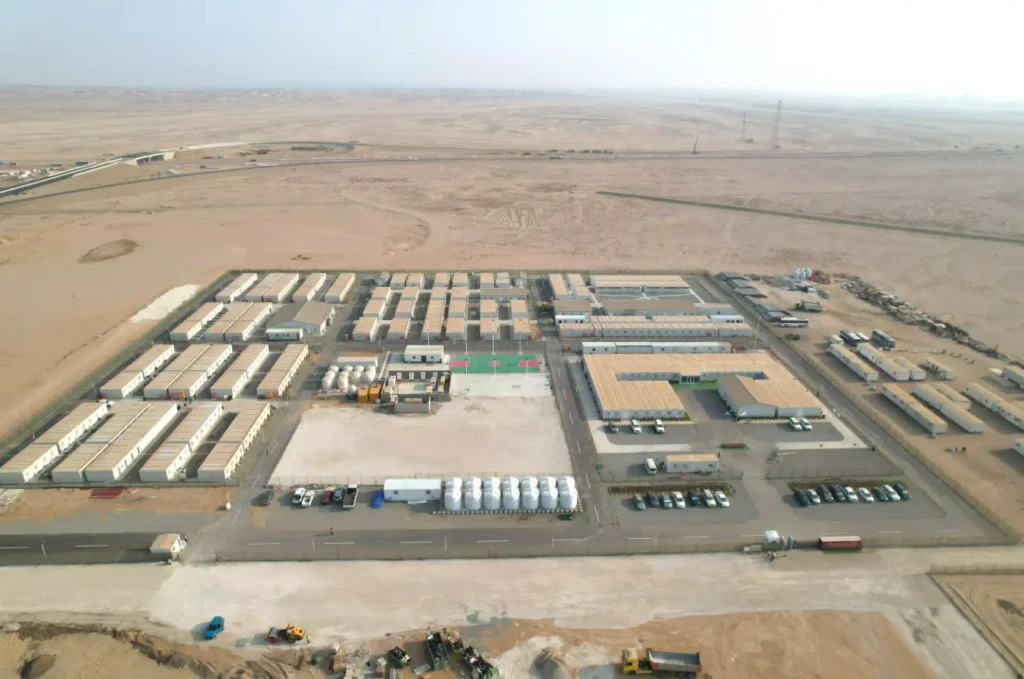
A practical modular worker camp design typically includes four areas:
Accommodation Zone
- Worker dormitories
- Supervisor accommodation
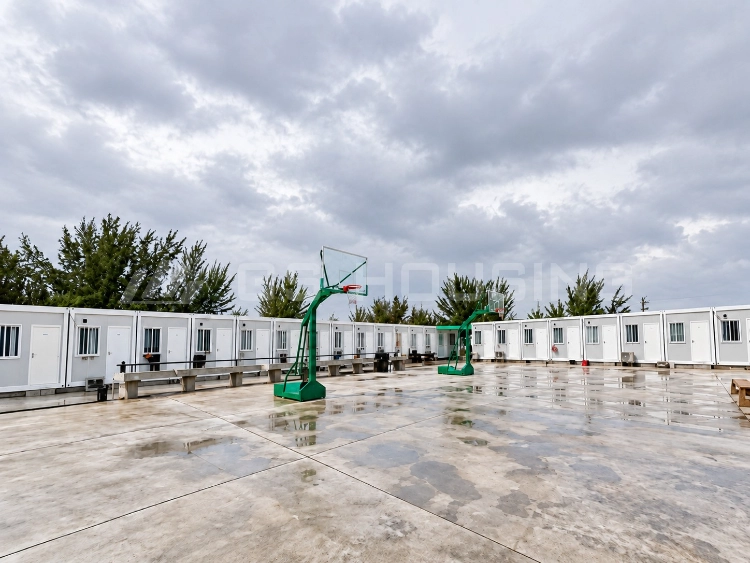
- Recreation spaces
Administration Zone
- Project management offices
- Engineering offices
- Meeting rooms
- Security offices
These spaces handle most daily communication for a typical construction site project.
Service Zone
- Dining hall
- Kitchen
- Laundry facilities
- Medical room
Logistics Zone
- Warehousing
- Equipment parking
- Material storage
- Waste management facilities
Separating these functions improves safety, reduces congestion, and simplifies future expansion.
Why Many 300 Person Worker Camps Should Be Planned for 500 Workers
Another common mistake is designing around current workforce numbers only.
Projects evolve.
A camp that starts with 300 workers may eventually support 500 workers or more.
Interestingly, expanding from 300 to 500 workers is often not an accommodation problem.
It’s a utility problem.
Power systems, dining facilities, water supply networks, wastewater treatment capacity, and circulation routes often require upgrades before additional accommodation blocks can even be installed.
That’s why experienced planners reserve expansion corridors from the beginning.
The camp operates efficiently at 300 workers today.
But it’s already prepared for tomorrow’s growth.
The Pakistan Hydropower Project That Planned Beyond Initial Workforce Numbers
A useful example comes from GS Housing’s 500-worker hydropower accommodation camp project in Pakistan.
The development included:
- Accommodation buildings
- Office facilities
- Dining halls
- Bathroom facilities
- Utility infrastructure
What makes the project relevant isn’t simply its size.
It’s the planning philosophy.
The camp was designed around long-term operations rather than initial occupancy alone.
That same principle applies to any 300-person workforce camp.

Why Flat Pack Container Houses Are Perfect for 300 Person Worker Camps
For a 300-person camp, transportation and installation often affect schedules as much as the buildings themselves.
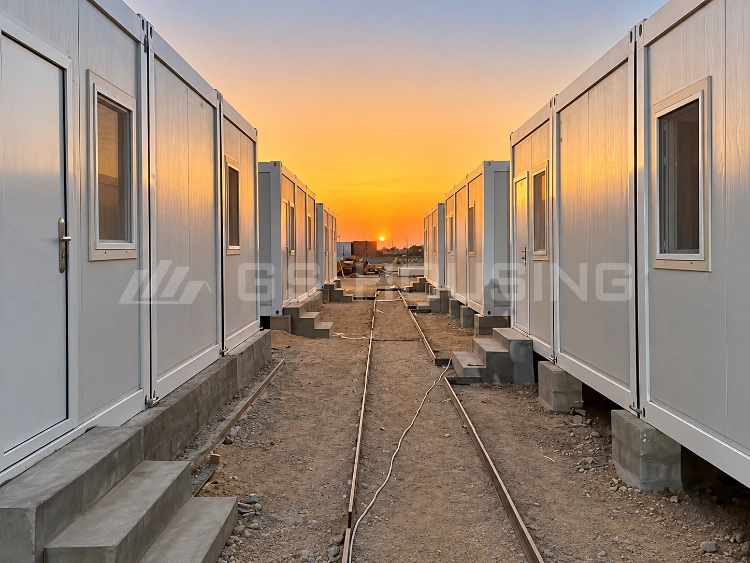
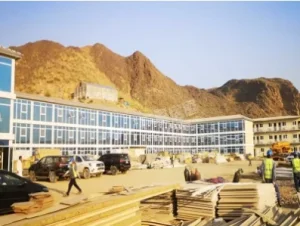
This is where flat pack container house systems for worker accommodation become attractive.
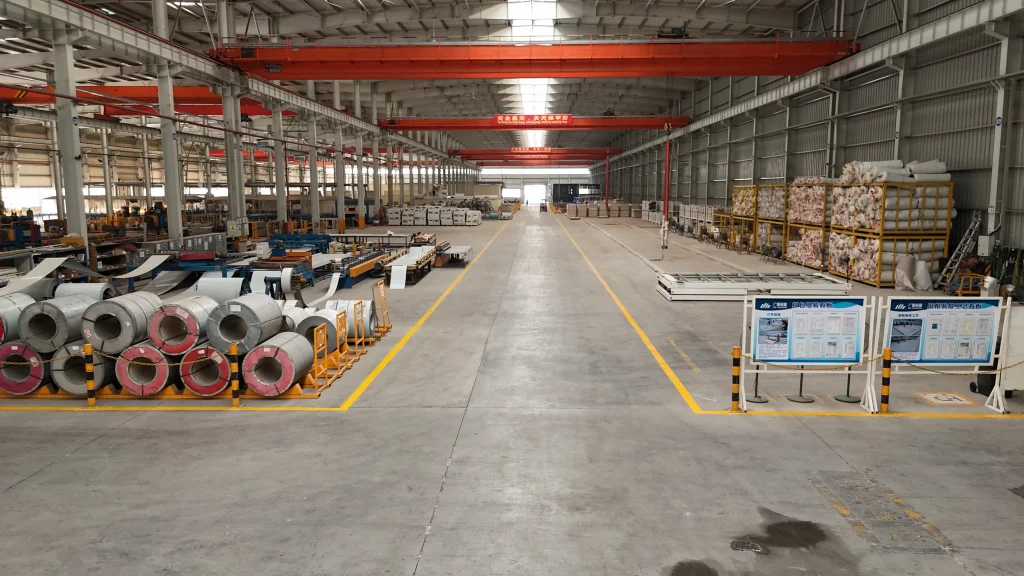
Most components are manufactured in the factory and delivered ready for assembly.
That means:
- No on-site welding
- No painting work
- Minimal structural fabrication on site
Assembly rates can approach 100%, significantly reducing site workloads.
Transportation efficiency is another major advantage.
A single 40-foot shipping container can transport approximately 300㎡ of prefabricated building components.
For inland delivery, that volume can typically be transported using:
- One 4.5-meter truck
- One 12.6-meter truck
with loading efficiency exceeding 90%.
Installation is equally fast.
Under normal conditions, a 300㎡ building can often be assembled in approximately five days.
For EPC projects working under tight schedules, that difference can directly affect workforce mobilization plans.

FAQ: Planning a 300 Person Worker Camp
Is it better to build a 300-person camp in one phase or two phases?
If workforce growth is expected within 6–12 months, reserving expansion areas and utility connections during Phase One often reduces future modification costs.
What is the most common planning mistake for 300 person worker camps?
Many contractors focus on accommodation capacity but underestimate dining, utility, and support facility requirements, leading to daily operational bottlenecks.
Can a modular worker camp be expanded later?
Yes. Most modular camp systems allow additional accommodation blocks and facilities to be added with minimal disruption to existing operations.
Can a worker camp be relocated after project completion?
In many cases, yes. Modular buildings can be dismantled, transported, and redeployed for future projects, improving long-term asset utilization.
Final Thoughts
The real question isn’t how many rooms a 300 person worker camp needs.
It’s how well the camp will operate once 300 people actually start living and working there.
Most 300-person camps don’t fail because they lack rooms.
They fail because support facilities, utilities, and circulation routes were never designed for how people actually use the camp.
That’s why experienced EPC contractors spend less time counting beds and more time planning operations.
If you’re evaluating workforce accommodation options, reviewing different modular worker camp design approaches early can help avoid costly adjustments later.
And if your workforce forecasts and site conditions are already defined, reviewing modular accommodation solutions for workforce camps can help identify the most practical layout and expansion strategy for your project.
If you’re currently planning a 300-500 person worker camp, you’re welcome to discuss your layout and capacity requirements with the GS Housing project team to receive a customized master plan recommendation.