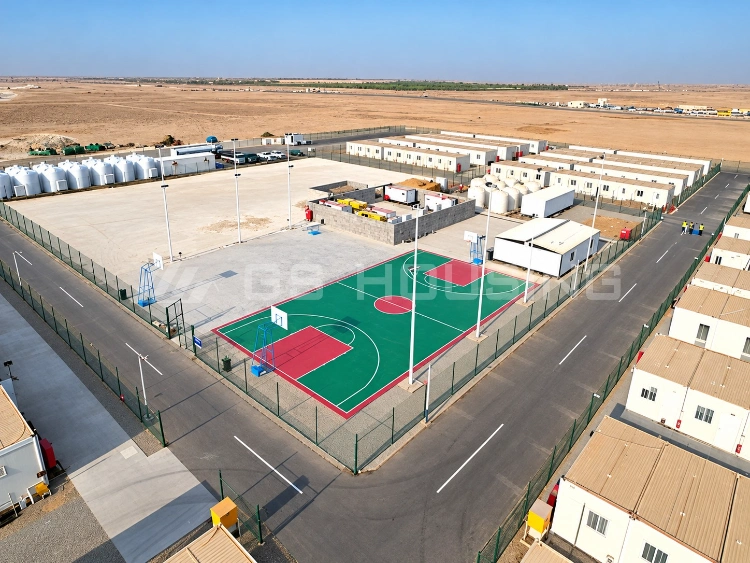
引言
In Saudi Arabia, projects rarely slow down because workers aren’t available.
More often, they slow down because workers arrive before the camp does.
It happens more often than many contractors expect.
The equipment is ready.
The schedule is approved.
The workforce mobilization plan is complete.
But accommodation isn’t operational yet.
Suddenly, a project that looked perfectly organized on paper starts losing valuable time before construction even reaches full speed.
That’s why a prefab labor camp Saudi Arabia project is rarely just about buildings.
It’s about keeping the entire project moving.
For large construction, infrastructure, energy, and oil & gas developments, workforce accommodation often becomes one of the first operational facilities that must be completed—not one of the last.
And in Saudi Arabia, the challenge goes beyond simply providing rooms.
Project teams must deal with:
- Extreme summer temperatures
- Sand and dust exposure
- Tight delivery schedules
- Remote project locations
- Workforce numbers that can change dramatically within months
As a result, many contractors now rely on modular camp Saudi Arabia solutions that can be manufactured off-site, delivered quickly, and expanded when project requirements evolve.
Experiences from GS Housing’s global modular camp projects across the Middle East, Africa, and Asia continue to show that accommodation planning often influences project schedules much earlier than many contractors initially expect.
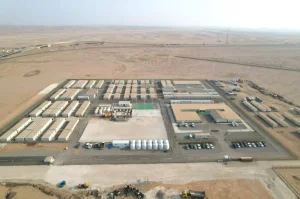
Most Delays Start Long Before Workers Move Into a Labor Camp Saudi Arabia Project
One common misconception is that accommodation is merely a support facility.
In reality, it often becomes a schedule driver.
A contractor cannot comfortably mobilize 800 workers into a remote location if accommodation, dining, sanitation, and support services aren’t operational.
For many labor camp Saudi Arabia projects, camp readiness directly affects construction readiness.
This becomes even more obvious outside major cities.
A remote project may face:
- Long transportation routes
- Limited local labor resources
- Restricted access to construction materials
- Harsh environmental conditions
Traditional construction can work.
The issue is predictability.
When dozens of subcontractors, suppliers, and project deadlines are interconnected, uncertainty becomes expensive.
That explains why many EPC contractors prioritize modular deployment during the earliest planning phases rather than treating workforce housing as a package to solve later.
The goal isn’t simply to build faster.
It’s to remove variables before they become problems.
Why Heat Is Usually Not the Biggest Problem in Worker Accommodation Saudi Arabia
When overseas buyers evaluate worker accommodation Saudi Arabia projects, most immediately focus on air conditioning.
Understandably so.
Summer temperatures regularly exceed 45°C.
But experienced camp operators often worry about something else first.
Dust.
Heat can be managed.
Dust is harder.
Fine desert particles find their way into:
- Ventilation systems
- Door seals
- Electrical equipment
- 室內裝潢
- Mechanical rooms
Poorly designed camps often experience maintenance issues long before structural issues appear.
Interestingly, one of the most expensive mistakes isn’t under-specifying cooling systems.
It’s relying on cooling systems alone.
Many project teams purchase larger HVAC units expecting better performance.
The result is often higher energy consumption rather than better comfort.
A better solution usually combines:
- High-performance insulation
- 反射型屋頂
- Proper ventilation design
- Dust-resistant detailing
- Quality door and window sealing
In other words, reducing heat gain often matters more than adding cooling capacity.
That sounds counterintuitive.
Yet it’s a lesson many facility managers learn during their first Saudi summer.
For long-duration projects, operating costs often reveal design mistakes much faster than procurement costs do.
This is one reason many contractors spend more time evaluating insulation performance and room layouts within worker accommodation solutions for remote industrial environments rather than comparing equipment specifications alone.
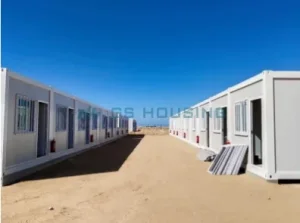
What Actually Gets Built Inside a Modern Prefab Labor Camp Saudi Arabia Development?
When people hear “labor camp,” they often picture rows of dormitories.
The reality is usually much closer to a temporary community.
A 1,000-person camp functions very differently from a housing project.
Workers eat there.
Sleep there.
Attend meetings there.
Sometimes spend months there.
Accommodation remains the largest component.
It is rarely the busiest one.
Dining facilities often generate more operational pressure than dormitories.
A typical prefab labor camp Saudi Arabia project may include:
住宿大樓
- 工人宿舍
- 主管辦公室
- 管理層住宿
- 隔離室
辦公室設施
- 專案管理辦公室
- 工程部門
- 會議室
- Security offices
- 文件控制室
餐飲基礎設施
- 工業廚房
- Cold storage facilities
- 食物處理區
- 餐廳
Support Facilities
- 洗衣房建築
- 禱告室
- 休閒場所
- Convenience stores
Sanitation Infrastructure
- 淋浴設施
- Toilet blocks
- 供水系統
- Wastewater treatment systems
One overlooked area is laundry capacity.
從表面上看,這似乎是件小事。.
In reality, workers operating in desert conditions may require daily uniform cleaning.
A camp that comfortably houses 2,000 workers may still struggle operationally if laundry facilities were designed for half that number.
For this reason, many project teams evaluate prefabricated camp systems designed for large workforce accommodation projects rather than selecting buildings individually and trying to connect them later.
The 10,000-Person Saudi Arabia Workforce Camp That Couldn’t Wait for Traditional Construction
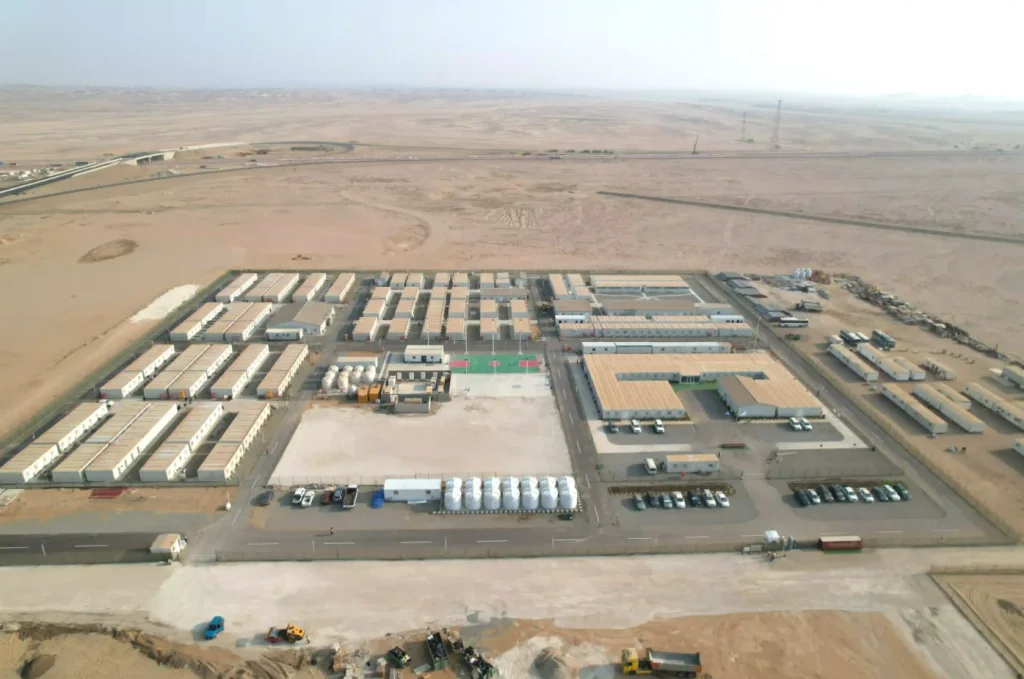
A useful example comes from GS Housing’s Saudi Arabia accommodation camp project supporting more than 10,000 personnel.
The challenge wasn’t simply scale.
Large camps are built every year.
The real challenge was speed.
The client needed accommodation for 10,000 workers operational within approximately six months.
Workforce accommodation had to be delivered quickly enough to support ongoing project activities while maintaining acceptable living standards in a harsh desert environment.
該開發專案最終包含:
- 住宿大樓
- 餐廳
- 辦公室設施
- 衛生基礎設施
- 休閒區
- Public support facilities
At this scale, the camp effectively functioned as a temporary town.
Building everything through conventional methods would have introduced significant schedule pressure.
Instead, modular construction allowed major portions of manufacturing to take place before shipment.
That reduced on-site construction workloads and improved deployment predictability.
Perhaps more importantly, the project could continue expanding as workforce requirements evolved.
That flexibility is often overlooked during procurement.
Buyers naturally focus on today’s workforce numbers.
The camp usually has to support tomorrow’s workforce numbers as well.
Project Reference:Saudi Arabia accommodation camp for 10,000 people
Not every Saudi project operates at that scale.
Some developments require accommodation for only a few hundred workers.
Others run for years and expand multiple times.
A similar approach can also be seen in GS Housing’s Saudi Build workforce accommodation project, where rapid deployment and phased expansion were equally important to keeping construction schedules on track.
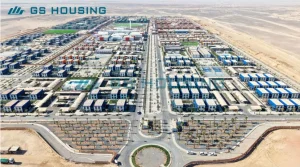
Why Many Modular Camp Saudi Arabia Projects Expand in Stages Instead of All at Once
Another assumption buyers frequently make is that camps should be built to full capacity immediately.
Sometimes that’s true.
Often it isn’t.
A highway project may start with 1,200 workers.
Reach 2,500 workers a year later.
Then grow again during peak construction.
Building for maximum capacity from day one can create unnecessary costs and underutilized infrastructure.
Many modular camp Saudi Arabia projects therefore expand in phases.
The approach helps reduce:
- Initial capital expenditure
- Utility demand
- Idle facilities
- Expansion risk
Modular construction works particularly well because additional accommodation, office, or dining units can be added with minimal disruption to existing operations.
For many contractors, flexibility ultimately creates more value than maximum initial capacity.
Does SASO Certification Matter More Than Buyers Think?
The short answer is yes.
But perhaps not for the reason many buyers assume.
Some procurement teams view SASO certification as paperwork.
In reality, it directly affects whether products can enter the Saudi market smoothly.
Units lacking proper compliance documentation may encounter customs delays, additional inspections, or approval issues.
And when accommodation is linked to project mobilization schedules, even small delays can become expensive.
Certification matters.
Logistics capability matters too.
Manufacturing reliability matters even more.
Experienced buyers usually evaluate all three.
Why Construction, Energy, Oilfield, and Infrastructure Projects Keep Choosing Modular Camps
The industries vary.
The reasons often don’t.
Whether the project involves highways, industrial facilities, renewable energy developments, oilfields, or large construction programs, project teams usually face the same pressures:
- Limited schedules
- Workforce fluctuations
- Remote locations
- Cost-control targets
- 未來的擴充需求
The objective is rarely just housing workers.
The objective is creating an operating environment that continues functioning smoothly as project demands evolve.
結語
The camps that perform best in Saudi Arabia are rarely the camps that cost the least at the beginning.
That’s probably the most misunderstood part of camp planning.
A lower purchase price may look attractive during procurement.
But operational problems are usually far more expensive than buildings.
Congestion.
Heat.
Poor layouts.
Difficult expansion.
Logistics bottlenecks.
Those issues tend to stay with a project long after procurement ends.
That’s why experienced project teams often start discussing accommodation much earlier than first-time buyers expect.
Not because camps are complicated.
Because changing decisions later usually is.
Every project faces different workforce numbers, site conditions, schedules, and operational priorities.
Reviewing similar developments before procurement often helps identify layout, expansion, and logistics challenges long before they become expensive problems.
For teams currently comparing options, the project examples and technical resources available through GS Housing 的模組化營地項目組合 can provide useful reference points when planning accommodation capacity, support facilities, and phased deployment strategies.
If workforce numbers, project duration, or site conditions are already becoming clearer, it may be worthwhile to discuss your Saudi Arabia camp requirements with our project team early in the planning process before transportation routes, accommodation capacity, and utility systems are finalized.