Oilfield Camps must provide more than a place to sleep. Remote energy sites need worker rooms, offices, sanitation, food service, and dependable access to water and power, often before main operations begin. A camp that arrives late or has an unsuitable layout can disrupt shift changes and daily work.
GS Housing offers a range of modular building systems for temporary accommodation, offices and industrial facilities that can be planned and ordered as individual buildings or as part of a single camp. When specifying a modular building solution for an oil and gas project, the question is not just how quickly it can be constructed, but also how well it will fit the location, the workforce and the operations that will be carried out there.
Why Do Energy Projects Need Modular Oilfield Camps?
Many oil and gas projects are located in remote areas where road access, utilities, and local construction resources may be limited. Under these conditions, workforce accommodation and supporting facilities often need to be planned before major site operations begin.
Remote Sites with Limited Infrastructure and Difficult Access
A remote location affects delivery vehicles, lifting equipment, foundation work, and utility connections. Before selecting a building type, the project team should check road access, unloading space, ground conditions, and the availability of water and wastewater treatment. Remote workforce accommodation works only when these supporting systems are coordinated with the buildings.
Worker Accommodation and Essential Camp Facilities
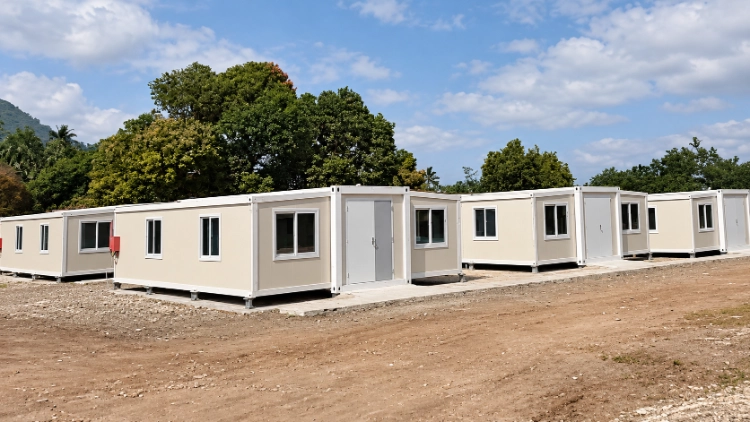
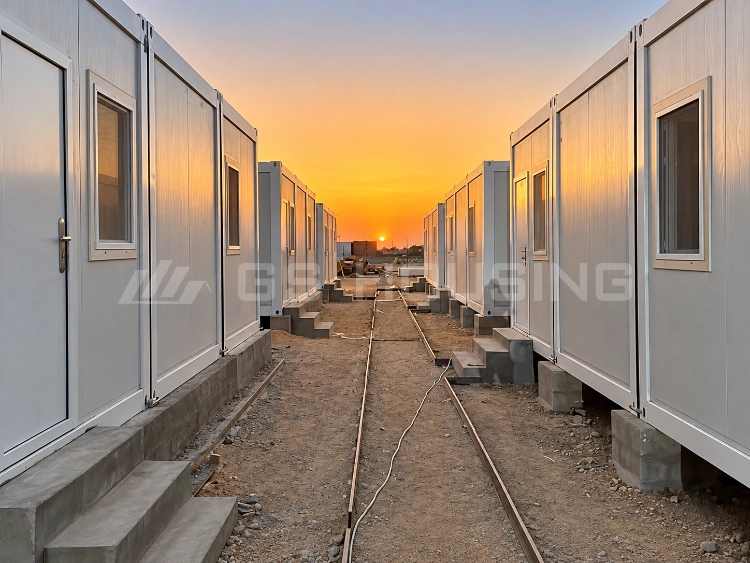
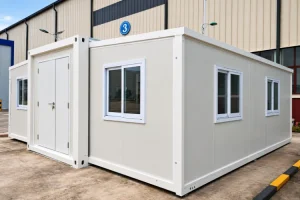
Sleeping rooms should be planned alongside toilets, showers, dining areas, laundry, first-aid rooms, and offices. Separate pedestrian routes from service traffic where possible, and place noisy operations away from sleeping quarters. GS Housing’s Modular Container Houses can be arranged as individual rooms or combined into larger functional areas, making them relevant to worker accommodation camps with mixed needs.
Changing Workforce Needs and Phased Camp Expansion
Workforce requirements at oil and gas projects can change during drilling, construction, commissioning, and operations. Camp occupancy may increase during peak project activities and decrease as operations stabilize, affecting the number of accommodation units and supporting facilities required.
Modular oilfield camps can be planned for phased delivery and expansion. Factory prefabrication can progress while foundations and utility connections are prepared on site, helping align camp delivery with workforce mobilization schedules.
To support future expansion, reconfiguration, or relocation where technically feasible, project teams should consider available space, lifting access, structural connections, and utility capacity during the initial planning stage. Late changes to room layouts or service interfaces may affect both factory production and on-site installation.
What Specific Advantages Do Modular Camps Offer Over Traditional Construction?
While relocating repetitive fabrication from remote site to specialized production environment simplifies scheduling, the key to successful off-site construction still lies with effective transport planning, correct on-site assembly and site-specific design.
Faster Installation for Time-Sensitive Energy Projects
Conventional buildings are typically framed, enclosed and fitted out in sequence on site. The offsite manufacture of building modules arrives on site with many components already prepared for construction and roof and base frames, corner columns, wall panels and integrated services all facilitate repeatable site assembly. The main benefit of fast construction is to meet project deadlines when on site there are few trades available to construct a building.
Simplified Logistics for Remote Project Locations
Контейнерні будинки у розібраному вигляді are packed components that are transported to a destination and then assembled. For remote isolated oilfield camps, shipping a number of packages containing all the necessary site-built materials to be connected together by different trades can be more easily managed than individual site-built houses. The buyer must check the dimensions of the packaged components, any access restrictions, the maximum capacity of the cranes to be used and how the components will be protected from damage during transport. Flat Pack Container Houses are particularly suitable for large numbers of similar houses to be used for a single project.
More Controlled Factory Production and Site Assembly
For flat-pack configurations, major structural components, including roof frames, base frames, corner columns, and wall panels, are manufactured and quality-checked in the factory. These components are then packed for transportation and assembled on site according to approved installation drawings.
Depending on the product configuration, electrical, plumbing, and interior components may be prepared or partially integrated before shipment. Final structural connections, weather sealing, utility connections, and installation quality must still be inspected on site.
Adapting Camp Design to Harsh Site Conditions
Modules will have been exposed to dust, heavy rain, heat and salt-laden air and hence will require wind-load calculations appropriate for the project as well as details of corrosion protection, insulation etc. and details of roof drainage and foundation anchorage. Oil and gas projects require additional consideration of hazardous-area classification, fire separation distances, emergency access, and electrical safety. Standard accommodation modules should not be assumed suitable for hazardous classified areas. Their location, structural requirements, fire protection measures, and electrical installations must be reviewed according to project-specific engineering and applicable local regulations.
How Should Companies Select the Right Modular Oilfield Camp Solution?
The best specification starts with occupancy and daily operations, not with a catalogue image. Buyers should develop a room schedule and review it together with site constraints before fixing unit quantities.
Match Camp Design with Workforce and Project Requirements
Note the peak number of residents, their shift patterns, requirements for privacy and use of shared facilities, such as kitchens, dining areas, storage, cleaning facilities, medical facilities and utility plant. For remote workforce accommodation, it’s better to reserve space for maintenance and emergency access than to fill every room with beds.
Choose Suitable Modular Products for Different Applications
Modular Container Houses fit projects requiring repeated room types and connected office or accommodation blocks. Flat Pack Container Houses suit phased delivery and locations where the assembly sequence can be organized on site. A third consideration is how frequently a building may be moved: repeated relocation calls for a review of lifting points, connection details, and service disconnection procedures. Select the building format based on transport access and actual operating needs, not appearance alone.
Evaluate Supplier Experience and Project Support Capability
Request from prospective suppliers for suppliers’ layout drawings, information on interface with foundations, full material specification, test records, commissioning instructions and a proposed delivery plan. Who packs? Who ships in stages? Who provides installation instructions? For oil and gas projects: who is responsible for local structural and fire regulations and who connects up water, drainage and electricity?
What Can Energy Companies Learn from GS Housing’s Modular Camp Project Experience?
An established remote camp project can show how accommodation and management space work together. It cannot, by itself, establish suitability for every oilfield environment.
Project Reference: Vanuatu Expandable Container Camp for Remote Deployment
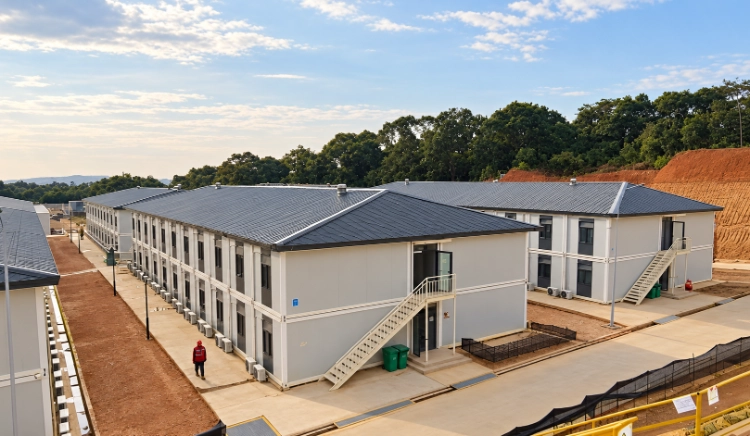
Цей Проєкт створення табору з розбірних контейнерів у Вануату combined expandable units for offices and staff accommodation. Its arrangement included bedrooms, bathrooms, a kitchen and dining area, and management workspace. This was not an oilfield project, but its mixed-use planning illustrates a relevant point: daily services must be designed as part of the camp rather than added after sleeping units are installed.
Modular Solutions Support Diverse Energy and Industrial Applications
Modular camp designs can be applied to a wide range of dispersed industrial projects including pipeline construction, processing-plant construction and mining. Although the physical building design may remain similar for a camp to be moved along a pipeline for example for relocatable accommodation for some team members and longer term offices and living facilities for the personnel stationed at pump stations, the foundation, services and move plan will vary for each stage of a project and thus the modular camp solution needs to be adapted for each project stage.
Why Choose GS Housing for Your Modular Oilfield Camp Project?
A coordinated supplier helps translate an occupancy plan into manufacturable modules and an installation sequence. The main value is to have fewer interfaces between building supply and site work that remain unresolved. This is what modular oilfield camps are all about – delivering parts of a camp in stages and allowing for changes in the layout.
Integrated Modular Building Services from Design to Delivery
GS Housing supports product selection, layout planning, manufacturing, delivery coordination, and installation guidance. Its prefabricated system allows units to form dormitories, offices, dining facilities, sanitation blocks, and other worker accommodation camps. Before placing an order, request a drawing set showing room allocation, module connections, service routes, and the work expected from the site contractor.
Зверніться до компанії GS Housing за рішеннями щодо розбудови таборів на нафтових родовищах
If your project is restricted by access, has varying numbers of staff and camp functions, define the proposed site location, required occupancy, a construction schedule and an assessment of available utilities prior to seeking a proposal. The technical team can then provide advice on a suitable design and highlight any design issues that require further clarification. Зв’яжіться з GS Housing to discuss customized oilfield camp solutions for worker accommodation, site offices, dining areas, sanitary facilities, medical rooms, storage, and other camp support needs.
Часті запитання
These questions often arise before a remote camp specification is approved.
What Facilities Should Oilfield Camps Include?
Typical facilities at an oilfield camp include sleeping rooms, toilets, showers, dining area, laundry, offices, storage and first aid facilities. The specific facilities will depend upon a number of factors including camp occupancy, shift routines, camp duration and local health and safety requirements.
Are Modular Oilfield Camps Suitable for Extreme Weather?
Such structures can be realized if the necessary requirements for structure, insulation, corrosion protection, drainage and anchoring are specified for the respective site. In addition to the general product description, please ask for the specific engineering information for the weather conditions expected for the respective site.
Can Oilfield Camps Be Expanded or Relocated as a Project Changes?
Check whether the individual modular units can be added or relocated later. Confirm available land, lifting and transport to site, connection to utilities and check connections for any movement after initial use. Moduar field camps can remain functional after initial construction.

Поділіться цією історією — оберіть платформу!
 Рішення щодо розміщення персоналу на гірничих таборах: повний посібник для гірничодобувних компаній та підрядників